




Autism 101 for Police, Detention Centers, Judges

Photo of a man dressed as judge who has various symbols representing the legal field, along with the rainbow-colored infinity symbol representing the autism spectrum. Photo Illustration: Alex Collinger.
Photo of a man dressed as judge who has various symbols representing the legal field, along with the rainbow infinity symbol representing the autism spectrum. Photo Illustration: Alex Collinger.

PITTSBURGH_Detention guards didn’t know why some incarcerated kids were biting and pinching their own arms and legs, pulling at their ears, and otherwise mutilating themselves. The youths were autistic.

“When we went in, it was just very apparent,” says psychologist Tammy Hughes. “But because (officers) hadn’t had the training, because they didn’t know what autism looked like, it was misunderstood.”

People with autism spectrum disorder [ASD] are seven times more likely than peers to be either crime victims–or suspected or actual perpetrators. 

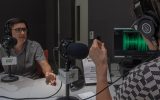
Listen to Hughes’ conversation with students at Joey Travolta/Arts for Autism Film Camp by pressing the red button with the white arrow.

Hughes trains police, judges, lawyers, and guards to recognize and address autism. She reminds people that autism is not synonymous with violence. This article is drawn from those conversations. Her training materials have been presented to over a thousand judges. But work remains.

It starts on the streets, sometimes in surprising ways. Hughes describes a case in Ohio, in which a young male with an affinity for blankets entered a house to check out a neighbor’s blankets.

Interviewee headshot

“In some window there was a blanket over a chair,” she says. “The door was open. He went in and was touching the blankets. Now, the people there were home and it did scare them. Quite seriously. But it was breaking and entering technically, but his motive for breaking and entering is not the same motive as you would see for somebody trying to steal…he didn’t steal anything.”

Yet the act was illegal and Hughes says that it isn’t just law enforcement that needs to be trained, but individuals with autism as well. This person, she says, needed to be able to answer the question, “How do I get my needs met in a way that’s not illegal?”

A single run-in with the police, even as a juvenile, can be enough to disrupt a person’s life. With a criminal record comes social stigma, barriers to housing and employment, and even longterm health problems. And studies show that the criminal justice system–from policing, to the courts, to correctional facilities–isn’t set up to address, consider, or even recognize ASD among youth.

Additionally, children can be charged and convicted as adults in court, depending on the details of the case. Hughes knows of kids as young as 14 who have been tried as adults in Allegheny County. Add immaturity on top of disability, and the outcome can be disturbing. 

“My whole job is to keep kids out of jail and in school,” says Tammy Hughes, a Duquesne University professor in the Department of Counseling, Psychology and Special Education. “A lot of the screenings in juvenile justice really only look at psychiatric problems and not at developmental disabilities.”

Take, for example, a routine traffic stop. Loud sirens, flashing lights, and a uniformed officer are frightening for most anyone. For those with ASD, it can feel especially overwhelming. 

Similarly, a police pat-down could cause an autistic person to flee or lash out. Suddenly a speeding ticket may escalate to a charge of resisting arrest or assault, all because the individual can’t negotiate the interaction and the police officer lacks the training to recognize autistic behavior.

“They look very criminal when they really are not,” Hughes says.

This miscommunication can also extend into the courtroom, says Hughes. A juvenile offender may appear to a courtroom and judge as angry, aggressive or lacking remorse.

“You can’t punish a child with a disability for a symptom, a trait of their disability” in a school setting, says Hughes, “but there’s no equal partner to that in juvenile justice.”

This article is based on conversations with C.S. Wyatt, host of The Autistic Me podcast, and Amanda Alcorn and Evan Koepfinger, students at Evolve Coaching’s Joey Travolta/Arts for Autism Film Camp. Click below for full audio and transcripts.

The All-Abilities Media Project is a collaboration between Unabridged Press and the Center for Media Innovation at Point Park University in downtown Pittsburgh. The author, Brian Conway is a freelance reporter. His environmental reporting was awarded in the Society of Professional Journalists’ Keystone Chapter Spotlight contest. His work has been published in Motherboard, October, and the Chicago Tribune. @BrianConwayyyyy

Rallying Businesses to Embrace Accessibility Law

PITTSBURGH_A campaign in the city’s university center–Oakland–is making one of the city’s most vibrant neighborhoods one of its most accessible. 

“Why do we have establishments that aren’t accessible? What could we be doing different?” says Georgia Petropoulos, Executive Director of the Oakland Business Improvement District and founding member of Oakland for All. “We have a group of dedicated individuals from the world of business, from the world of universities and hospitals, nonprofits, advocacy, meeting monthly and strategizing, ‘Well, how do we do this?’”

Sushi Fuku owner Ting Yen spent over $14,000 to regrade a public sidewalk for customers who use wheelchairs–about half was reimbursed through state funding. Photo: Nick Tommarello.

Many business owners think they’re not required to comply with the ADA because their buildings predate the act’s passage 30 years ago–a false assumption. Informed by Oakland for All, OBID points business owners toward funding to mitigate the cost of upgrades, connects them with architects who can make compliance modifications, and reminds businesses that people with wheelchairs have money to spend on food.

Petropoulos says the program came about after meetings with local accessibility advocates. One of those advocates is Alisa Grishman. Along with Josie Badger, she interviews Petropoulos and business owner Ting Yen in the first segment of the Around the World in ADA podcast.

“[They] came to us and said, ‘You know, there’s actually some establishments that we can’t get into, and we’d love to work with you and figure out how we can make this change,’” Petropoulos says.

One of the first business owners on board was Ting Yen, owner of Oakland restaurant group Sushi Fuku. A University of Pittsburgh graduate, Yen came to the United States from Taiwan in 1991, and now lives in Oakland. He says he always thought his building was accessible–since he says that is what his architect told him. But while it was compliant inside, the business lacked a ramp to bridge the single step from the sidewalk. 

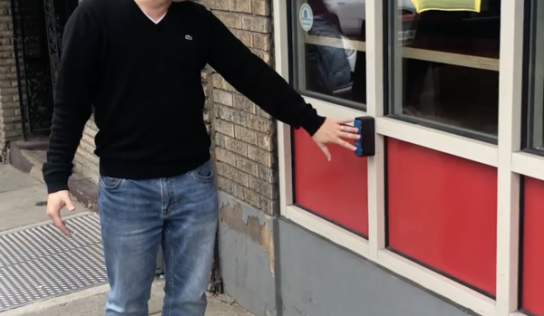
Yen spent a little over $14,000 to regrade the sidewalk. About half of that amount was reimbursed by OBID from state funding. And he’s also installed a new automatic door push button. The previous one was higher up on the ramp, where people in wheelchairs would have to wait on a slope for the door to open. The new button allows the door to be opened by the time a person travels up the ramp. Yen’s building is now fully accessible.

The Ramp Crawl encourages people with disabilities to show up en masse at accessible bars with their able-bodied peers in Pittsburgh’s Oakland. There’s a special effort on this day to ensure access for those using wheelchairs. Photo: Oakland Business Improvement District

Oakland for All’s most successful event is its annual Ramp Crawl. Just like any bar crawl, the event invites people to eat and drink at Oakland’s accessible bars–with a particular focus on participation by people in wheelchairs. And wheelchair users do show up en masse.

The benefits of accessibility can extend beyond having more potential customers, Petropoulos and Yen agree.

“It just feels good to be in the community,” says Yen, “to help to contribute to the community, and to do what I can as a business owner.”

Unabridged Press produces The Around the World in ADA podcast in collaboration with the Center for Media Innovation at Point Park University in downtown Pittsburgh. It’s part of the All-Abilities Media Project supported by the FISA Foundation.