



Speaking, Acting and Teaching: 8 Disability Stories

BY RIANNE LINDSEY FOR UNABRIDGED PRESS

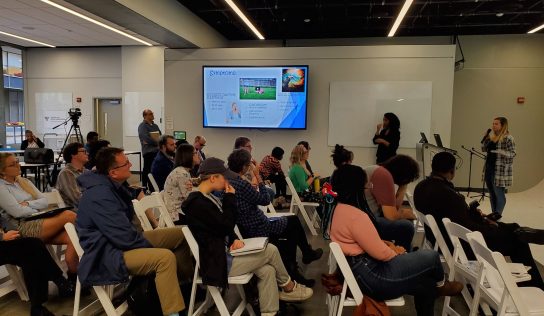
PITTSBURGH_“It’s the power of not yet,” special education teacher’s aide Michelle Steiner told about 50 people gathered at the Center for Media Innovation at Point Park University. 

“Just because somebody isn’t doing it now, doesn’t mean they are never going to be able to do it,” Steiner said. As a teacher in Butler, Steiner has taught this lesson to her students.

Steiner’s words were informed by Carol Dweck, a psychologist who popularized research about motivation, and why people do, or don’t, succeed.  

Steiner was one of 10 speakers who participated in the Dis/Ability Show & Tell: A Community Symposium in October. She talked about her personal journey, which led her to educating a new generation of people with disabilities. Steiner has a learning disability, and eventually felt empowered to ask for accommodations, despite her fears of stigma. She earned an associate degree from community college, and a bachelor’s degree from Slippery Rock University, where she made the Dean’s List.

Throughout the afternoon symposium, the speakers presented videos, photos, and a dramatic reading of a personal essay to share their experiences. Speakers included:

  • Emily Harnett, a theatre student in Point Park’s Conservatory program, shared her experiences of living with a physical disability, and working in a physically demanding field. Harnett read a spoken word piece she wrote about her diagnosis with Ehlers-Danlos syndrome, and her fear of not being able to perform on stage.
  • Tirzah DeCaria, co-founder of Creative Citizen Studios, strives to break down boundaries through art. She connects her group of artists, who have intellectual and developmental disabilities, with the broader arts community. She talked about the visual arts classes and workshops that her organization holds for people with disabilities. 
Jade Steele. Photo: Joseph Smith/Benevolent Photos.
  • An education student at Point Park, Jade Steele, presented information about the International Board of Credentialing and Continuing Education Standards (IBCCES) and Certified Autism Centers. These are organizations where at least 80 percent of staff training is defined in the field of autism and is committed to ongoing training and autism,” Steele said. Kennywood Park, where Steele works, is newly certified She said being certified helps both people with Autism Spectrum Disorder, and businesses, which see an increase in revenue when they become more inclusive. Steele, diagnosed with both ADHD and autism, shared her dream to educate students with disabilities.
  • Point Park student Regan Tischler was diagnosed with narcolepsy and cataplexy in her senior year of high school. Cataplexy, Tischler says, is a loss of muscle control with high emotion, such as laughter. She jokingly described it as it appearing to be intoxicated. She also explained that narcolepsy isn’t randomly passing out in public. It’s living with the knowledge that sometimes, “you will feel like you haven’t slept in like three days,” she said. Other symptoms include lucid dreaming, sleep paralysis, and hallucinations, in more extreme cases. 
  • Alicia DiGiorgi, Head of Production at the Pittsburgh Playhouse and one of the founders of the Pittsburgh Playhouse Accessibility and Inclusion Committee, spoke about the production she worked on under Bricolage Theatre Company, which led to the creation of the committee. She was inspired by the experiences she had with Bricolage, which has its own mission of inclusivity, and was able to get the funding and support needed to offer more accessible programming and services at the Playhouse. While it has been a huge undertaking, DiGiorgi said all of the work has been worth it. “I believe with an open mind, positive outlook, willingness to learn, a little bit of patience, and the proper support system, we can teach our future theatre makers how important it is to include everyone in the adventure [of theatre,]” she said.
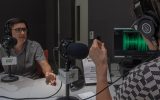
  • The afternoon ended with an on-stage interview by WESA-FM’s Bill O’Driscoll, who spoke with Point Park alumnus Brian Rutherford. Rutherford is a former Walt Disney World Entertainment costuming manager. At 38, Rutherford suffered four strokes, causing him to lose his eyesight. In a discussion with O’Driscoll, Rutherford talked about his current position as a costume stitcher with the Blind & Vision Rehabilitation Services of Pittsburgh.  He also serves as an audio description coordinator and a consultant to theatres in Pittsburgh. Rutherford says he wishes to see younger people from the blind community in the wings, on stage, and in the audience. He said, “I want to have young people realize the arts can be an accessible thing.” 
90.5FM WESA Reporter Bill ODriscoll. Photo: Joseph Smith/Benevolent Photos.

Center for Media Innovation graduate assistant Stacey Federoff and Unabridged Press’ Jennifer Szweda Jordan. Unabridged Press’ Look Who’s Here! founding host Erin Gannon, (who has Down syndrome), and Jordan (who has bipolar depression) also spoke about the beginnings of the All-Abilities Media Project–the work of this effort constitutes most of Unabridged Press’ work in the last few years and can be found throughout this website.

The symposium was inspired by a previous Halloween Symposium held at the center, later dubbed, “Decomposium.”

“At that event, students and staff shared research, choreography about ghosts, and short horror films. I thought, ‘Let’s do a symposium about disability–a kind of show and tell about disability,’” Jordan said. “So, it’s an incredible privilege to have been part of making this happen.” 

Rianne Lindsey, who wrote this piece and appears in a video above as a participant in the symposium is a theatre student at Point Park. She spoke about the future of inclusion of people with disabilities in theater.

The Dis/Ability Show & Tell was made possible with help from Point Park graduate assistant Stacey Federoff, the school’s Center for Inclusive Excellence, and funders, including the FISA Foundation. 

Autism 101 for Police, Detention Centers, Judges

Photo of a man dressed as judge who has various symbols representing the legal field, along with the rainbow-colored infinity symbol representing the autism spectrum. Photo Illustration: Alex Collinger.
Photo of a man dressed as judge who has various symbols representing the legal field, along with the rainbow infinity symbol representing the autism spectrum. Photo Illustration: Alex Collinger.

PITTSBURGH_Detention guards didn’t know why some incarcerated kids were biting and pinching their own arms and legs, pulling at their ears, and otherwise mutilating themselves. The youths were autistic.

“When we went in, it was just very apparent,” says psychologist Tammy Hughes. “But because (officers) hadn’t had the training, because they didn’t know what autism looked like, it was misunderstood.”

People with autism spectrum disorder [ASD] are seven times more likely than peers to be either crime victims–or suspected or actual perpetrators. 

Listen to Hughes’ conversation with students at Joey Travolta/Arts for Autism Film Camp by pressing the red button with the white arrow.

Hughes trains police, judges, lawyers, and guards to recognize and address autism. She reminds people that autism is not synonymous with violence. This article is drawn from those conversations. Her training materials have been presented to over a thousand judges. But work remains.

It starts on the streets, sometimes in surprising ways. Hughes describes a case in Ohio, in which a young male with an affinity for blankets entered a house to check out a neighbor’s blankets.

Interviewee headshot

“In some window there was a blanket over a chair,” she says. “The door was open. He went in and was touching the blankets. Now, the people there were home and it did scare them. Quite seriously. But it was breaking and entering technically, but his motive for breaking and entering is not the same motive as you would see for somebody trying to steal…he didn’t steal anything.”

Yet the act was illegal and Hughes says that it isn’t just law enforcement that needs to be trained, but individuals with autism as well. This person, she says, needed to be able to answer the question, “How do I get my needs met in a way that’s not illegal?”

A single run-in with the police, even as a juvenile, can be enough to disrupt a person’s life. With a criminal record comes social stigma, barriers to housing and employment, and even longterm health problems. And studies show that the criminal justice system–from policing, to the courts, to correctional facilities–isn’t set up to address, consider, or even recognize ASD among youth.

Additionally, children can be charged and convicted as adults in court, depending on the details of the case. Hughes knows of kids as young as 14 who have been tried as adults in Allegheny County. Add immaturity on top of disability, and the outcome can be disturbing. 

“My whole job is to keep kids out of jail and in school,” says Tammy Hughes, a Duquesne University professor in the Department of Counseling, Psychology and Special Education. “A lot of the screenings in juvenile justice really only look at psychiatric problems and not at developmental disabilities.”

Take, for example, a routine traffic stop. Loud sirens, flashing lights, and a uniformed officer are frightening for most anyone. For those with ASD, it can feel especially overwhelming. 

Similarly, a police pat-down could cause an autistic person to flee or lash out. Suddenly a speeding ticket may escalate to a charge of resisting arrest or assault, all because the individual can’t negotiate the interaction and the police officer lacks the training to recognize autistic behavior.

“They look very criminal when they really are not,” Hughes says.

This miscommunication can also extend into the courtroom, says Hughes. A juvenile offender may appear to a courtroom and judge as angry, aggressive or lacking remorse.

“You can’t punish a child with a disability for a symptom, a trait of their disability” in a school setting, says Hughes, “but there’s no equal partner to that in juvenile justice.”

This article is based on conversations with C.S. Wyatt, host of The Autistic Me podcast, and Amanda Alcorn and Evan Koepfinger, students at Evolve Coaching’s Joey Travolta/Arts for Autism Film Camp. Click below for full audio and transcripts.

The All-Abilities Media Project is a collaboration between Unabridged Press and the Center for Media Innovation at Point Park University in downtown Pittsburgh. The author, Brian Conway is a freelance reporter. His environmental reporting was awarded in the Society of Professional Journalists’ Keystone Chapter Spotlight contest. His work has been published in Motherboard, October, and the Chicago Tribune. @BrianConwayyyyy