



What’s changed 30 years after the Americans with Disabilities Act promised access to education, the workplace, shopping, and more (religious institutions got themselves out of the law)? That’s what our newest series explores.
The Around the World in ADA podcast is hosted by disability advocates Josie Badger and Alisa Grishman. It’s part of the All-Abilities Media Project produced by Unabridged Press and the Center for Media Innovation at Point Park University with support from the FISA Foundation. We’re gearing up for the 30th anniversary of the Americans with Disabilities Act in 2020.
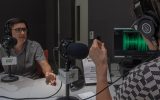
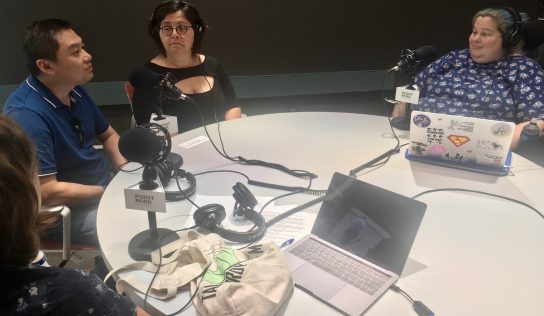
Recording the first episodes of the Around the World in ADA podcast: from left, Josie Badger, Ting Yen, Georgia Petropoulos, and Alisa Grishman.
Josie and Alisa are experts about how life works–and doesn’t–for the 20 percent of Americans with disabilities, due to their lived experience as well as 24-7 involvement in education and action at the local and national levels. Watch Josie’s TEDx Pittsburgh talk here, and read about Alisa here.
PITTSBURGH_A campaign in the city’s university center–Oakland–is making one of the city’s most vibrant neighborhoods one of its most accessible.

“Why do we have establishments that aren’t accessible? What could we be doing different?” says Georgia Petropoulos, Executive Director of the Oakland Business Improvement District and founding member of Oakland for All. “We have a group of dedicated individuals from the world of business, from the world of universities and hospitals, nonprofits, advocacy, meeting monthly and strategizing, ‘Well, how do we do this?’”
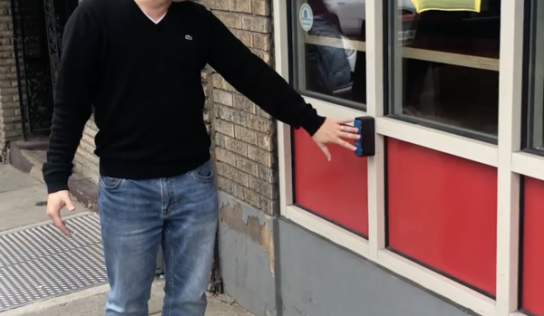
Sushi Fuku owner Ting Yen spent over $14,000 to regrade a public sidewalk for customers who use wheelchairs–about half was reimbursed through state funding. Photo: Nick Tommarello.
Many business owners think they’re not required to comply with the ADA because their buildings predate the act’s passage 30 years ago–a false assumption. Informed by Oakland for All, OBID points business owners toward funding to mitigate the cost of upgrades, connects them with architects who can make compliance modifications, and reminds businesses that people with wheelchairs have money to spend on food.
Petropoulos says the program came about after meetings with local accessibility advocates. One of those advocates is Alisa Grishman. Along with Josie Badger, she interviews Petropoulos and business owner Ting Yen in the first segment of the Around the World in ADA podcast.
“[They] came to us and said, ‘You know, there’s actually some establishments that we can’t get into, and we’d love to work with you and figure out how we can make this change,’” Petropoulos says.
One of the first business owners on board was Ting Yen, owner of Oakland restaurant group Sushi Fuku. A University of Pittsburgh graduate, Yen came to the United States from Taiwan in 1991, and now lives in Oakland. He says he always thought his building was accessible–since he says that is what his architect told him. But while it was compliant inside, the business lacked a ramp to bridge the single step from the sidewalk.
Yen spent a little over $14,000 to regrade the sidewalk. About half of that amount was reimbursed by OBID from state funding. And he’s also installed a new automatic door push button. The previous one was higher up on the ramp, where people in wheelchairs would have to wait on a slope for the door to open. The new button allows the door to be opened by the time a person travels up the ramp. Yen’s building is now fully accessible.
The Ramp Crawl encourages people with disabilities to show up en masse at accessible bars with their able-bodied peers in Pittsburgh’s Oakland. There’s a special effort on this day to ensure access for those using wheelchairs. Photo: Oakland Business Improvement District
Oakland for All’s most successful event is its annual Ramp Crawl. Just like any bar crawl, the event invites people to eat and drink at Oakland’s accessible bars–with a particular focus on participation by people in wheelchairs. And wheelchair users do show up en masse.
The benefits of accessibility can extend beyond having more potential customers, Petropoulos and Yen agree.
“It just feels good to be in the community,” says Yen, “to help to contribute to the community, and to do what I can as a business owner.”
Unabridged Press produces The Around the World in ADA podcast in collaboration with the Center for Media Innovation at Point Park University in downtown Pittsburgh. It’s part of the All-Abilities Media Project supported by the FISA Foundation.
Go Around the World in ADAs (Americans with Disabilities Act) with us on December 5!
See highlights of 2019 media including: Dining with a Disability, Dynamic Kayaking, and one Drummer Drumming. And then–dance with us a bit, and get your minute of fame as we record readings of the ADA to use in a future video. The ADA turns 30 next year!
This event takes pm at the GRW Theater in the University Center of Point Park University at , downtown Pittsburgh. Reserve seats here!
Brought to you by the Center for Media Innovation at Point Park University and Unabridged Press with support from the FISA Foundation and other anonymous donors.