

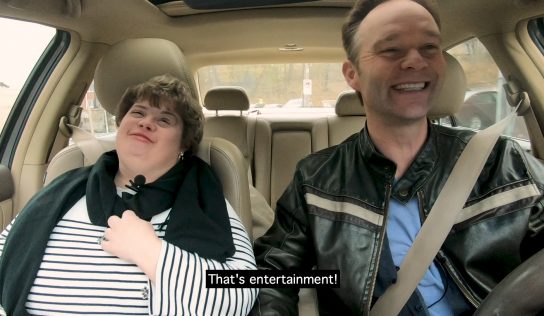
Look Who’s Here! Dashboard Jam with Broadway Vet Billy Hartung

Billy Hartung’s danced and acted on stages and screens from Pittsburgh to Broadway and back. His career began at the Center for Theater Arts–a performing arts school he now runs. He’s still acting around town, and at home, he plays a lead role as a husband and father of six.

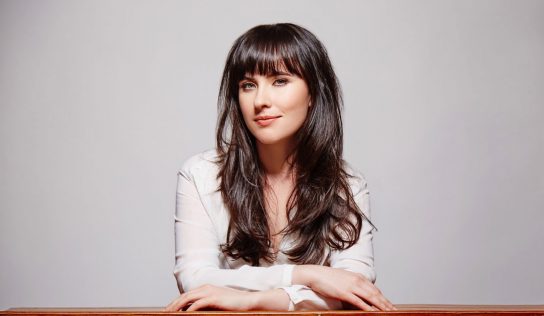
Our Look Who’s Here! host Erin Gannon is known for her dancing–on the bus, while walking to work, and anywhere else fun music is playing. She, too, started her performing career at the Center for Theater Arts.

So it was only natural these two would come together for our first Dashboard Jam episode of Look Who’s Here! 

We reached out to Awesome Pittsburgh for funding. The central message of our pitch: People with disabilities often have the same human curiosity and joy in music and good conversation that connects us all, whether or not we identify as having a disability. The Awesome Pittsburgh folks said “Yes!” to our idea.

Our All-Abilities cast and crew and got to work. That crew includes Virtual Homey’s Matthew Torti on cameras and editing and ALVA Media’s Alex Collinger (a Joey Travolta Film Camp grad). We premiered the completed video on Jan. 30–a frigid day in our home base of Pittsburgh. We hoped it would warm our audience up!

We also have an audio-described version below for the visually impaired, or anyone who can benefit from an additional description.

Podcast Workshops Open for People With Disabilities

UPDATE: Limited openings available! If you’re interested, please apply ASAP.

PITTSBURGH_People with disabilities are invited to workshops teaching the art of news interviewing, and podcast and video technology–workshops led by seasoned pros and supported by skilled journalism students at the stunning Point Park University Center for Media Innovation.

By hosting these workshops, as well as events, Unabridged Press and the Center for Media Innovation support greater diversity in the public conversation about inclusion in education, work, and public safety. The workshops lead up to the 30th anniversary of the Americans with Disabilities Act in 2020.

In the Point Park studio Inclusion advocate Chaz Kellem is captured on camera by Point Park University’s Claire Costello

This effort builds on the success of Look Who’s Here! All-Abilities Media, in which hosts Erin Gannon, and Mark Steidl, won Golden Quill Awards in 2018 from the Press Club of Western Pennsylvania.

Workshops are coordinated by Unabridged Press’ Jennifer Szweda Jordan, who won ACHIEVA’s 2018 Yvonne Zanos Excellence in Media Award for her work with Erin, Mark, and others with disabilities.

“I’ve heard from many others who want to try podcasting to share the opportunities they’ve experienced–as well as to learn and circulate new information,” says Ms. Jordan. “I’ve also heard from professionals who want to help mentor participants with this groundbreaking project, including the author of the best-selling Miracle in the Andes Vince Rause! And the Center for Media Innovation is the best possible hub to bring everyone together.”

erin and neilImage: MLB Player Neil Walker during interview with Erin Gannon at Point Park University’s Center for Media Innovation.

At the first session, participants will be interviewed and learn to interview. The interviews will be recorded and edited by Point Park students. Participants will also select someone in the community they will interview in the second session. Examples include special education advocates and employment transition specialists. These interviews will also be recorded and edited. Interviews will be published to educate the community and inspire dialogue via Unabridged Press channels, and other news outlets in Pittsburgh, as well as at a public event in late 2019. Participant work may also be submitted for journalism awards.

These workshops are generously supported by FISA Foundation. The mission of FISA is to build a culture of respect and improve the quality of life for three populations in southwestern Pennsylvania: women, girls and people with disabilities.

Interested participants for this or future workshops can apply at this link. Application deadline for March workshops is midnight Feb. 14. Workshop fee is $75 per person for two sessions. Through the generosity of the FISA Foundation, subsidies are available if cost is a barrier. For more information, email

#MeToo Times Seven: Commentary

She was in a coma for more than a decade. And, yet, she gave birth–obviously raped months before.

The victim went into labor in the last days of 2018 in Arizona. Evidently no one had noticed the woman was pregnant before that time. Police are now investigating the crime that took place in a private nursing facility, called Hacienda Healthcare, in Phoenix.

If it sounds so bizarre that it might be what’s now called “fake news,” but, sadly, it’s not. People who are compromised mentally and physically are at great risk for abuse.

In fact, one group, people with intellectual disabilities are sexually assaulted more than seven times as much as those without disabilities, according to a 2017 NPR news investigation drawn from previously unpublished U.S. Justice Department data. This rate of intimate assault against people who have issues like Down syndrome is a little-known sidebar in the age of #MeToo. These numbers don’t even count abuses in group homes.

And yet, many of us bypass this kind of news. It may not sink in because we can’t relate.

Back of person with T-shirt with anti-assault logos

U.S. Army photo by Sgt. Ashley Bell.

“We do not value the lives of people with disabilities the way we value our own lives,” said Joe Shapiro, the longtime NPR disabilities reporter who led the investigation, and who recently spoke in Pittsburgh.

If you’re not convinced by Justice Department data, or NPR, let me add my voice to the chorus. I’m a longtime caregiver of adults with intellectual disabilities, and I can tell you that abuse is real–sexual, financial, physical, and emotional.

Sometimes it makes headlines. In 2016 in Pittsburgh, ACCESS van driver Daniel Burrelli was sentenced to 6 to 16 years in prison for repeatedly raping a passenger who had Down syndrome.

“I am a man,” Burrelli said in an affidavit. “I have physical needs.”

Abuse is certainly not happening daily to all of the people I work with, but for many, it will happen at some point in their lives. Repercussions can last many years, particularly for those who cannot verbalize what has happened to them.

The threats expand and morph. These days, those of us who care for people with intellectual disabilities must be aware of more opportunities to engage with the world that also come with risks–like social media. Many people with intellectual disabilities have mobile devices and Facebook accounts, and they may not see the harm in inviting a new online friend to the house. Some people with intellectual disabilities use Uber or Lyft, and some we could never imagine doing so safely.

Each time I learn of a new abuse, it’s a wakeup call. It infuriates me, and also makes me up my game to ensure I’m doing my best to help keep vulnerable people safe. The nearest I’ve been at the time of a potential abuse was when a man was obviously leering and standing too close–and then closer–to one of my charges while we were at a Rex Theater concert. The guy was pounding beers and seemed like bad news. I danced myself between them, and stayed there all night.

I’m certainly not perfect in my caregiving. Once I waited longer than I should have to question or report scratches on a person’s skin after that person visited someone. It didn’t turn out to be an issue, but a wise friend reminded me to ask myself if I was being neglectful. It’s a tough word–neglect–to hear applied to yourself. But hyper-vigilance is called for when caring for vulnerable people.

Naturally we all want people with disabilities to have as much engagement in the world as possible. And, of course, that comes with risks. There seems to be a media fascination lately with championing opportunities for sexual relationships among people with disabilities. Friends have asked me–often with a giggle that I read as a little salacious–if the people I care for have sex or date.

Some do. Some don’t. But for those of us who are closest to them–when we know someone can’t read the danger signals, well, we dance between them and possible harm.

Many won’t get this opportunity to walk with people with disabilities through these subtle or more obvious risks. But what many of us can do is to start paying attention to vulnerable people and the issues they face. We might even do this for selfish reasons. Most of us will have a disability if we live long enough. You or someone you love will likely end up relying on caregivers who come to the job with their own mix of goodness and vice. It only makes sense as a society to advocate utmost vigilance now in caring for people who cannot fully care for themselves.

A good place to start paying attention is by listening to Shapiro’s series on sex abuse of people with intellectual disabilities. It’s called Abused and Betrayed and features voices of people who were victimized. It won the National Center for Disability Journalism’s highest honor last year–first place in the Ruderman Awards for Excellence in Reporting on Disability. In fact, all the award winners warrant attention.

Here at Unabridged Press, we believe our project, Look Who’s Here! All-Abilities Media, will be a driving force in helping people with disabilities make their voices more prominent in the public conversation about their own welfare–which is really the welfare of us all. Please visit often as we share interviews about education, work, arts, health, public safety and more.

If you are a person with a disability who’s been abused, or want to learn more, here is one good resource.